
ITALY | Energy Release 2.0: Navigating the Competitive Auction
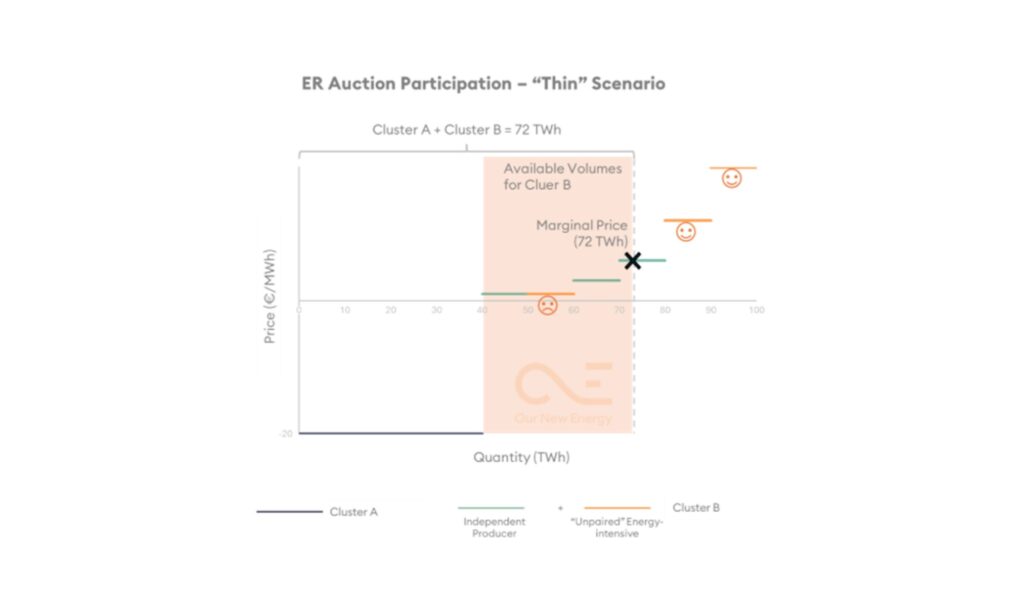
Energy Release 2.0: Navigating the Competitive Auction Get in touch ITALY | SOLAR – Energy Release 2.0: Navigating the Competitive Auction The Competitive Procedure: GSE objective is to build the RES capacity at the cheapest price to the system The ultimate objective of the Energy Release 2.0 competitive procedure is to facilitate the development of new renewable generation capacity, thereby fulfilling restitution obligations at the lowest possible cost to the system. This cost is anchored around 65 €/MWh (bruto of GO value), adjusted by a premium (or discount) offered by participants. The mechanism functions as an auction-based competitive procedure, where participants are ranked based on their offered premium, in ascending order. Premiums can be negative, but down to a minimum floor of -20 €/MWh. All awarded parties will then settle to a level of premium equal to the marginal price value. Eligibility to participate in the auction extends broadly, encompassing energy-intensive corporates and aggregators for volumes not covered by existing addendums, delegated third-party producers for both the volumes under existing Addendums and the spare volumes, the independent third-party producers. It is possible to find a detailed overview of the requirements for independent third-party producers in our article «Italy Solar Energy Release 2.0: Bilateral Deals Trends”. Timewise, the competitive procedure is expected to open in mid-March 2026 and close after 30 days. Also, according to the rules, auction results publication is then expected within 45 days, reaching the second half of May 2026. For EICs, the objective is to lose the auction Participants with a successful outcome from the auction will assume responsibility for both the construction of new capacity and the restitution obligations for the awarded volumes. Therefore, the intention of energy-intensive corporates and aggregators (hereby combined “EICs”) participating in the auction is to ultimately lose it. This will happen if their requested premium exceeds the value of the marginal one, allowing them to be released from the obligations of constructing new capacity and directly restituting volumes under ER, obligations which will be taken over by an independent third-party producer. In the above scenario, the EIC will pay GSE the marginal premium multiplied by its anticipation volumes, and GSE will then pass such premium to the awarded independent third-party producer, who has won the auction, at the asset COD. Conversely, if an EIC wins the auction, it remains responsible for the construction and restitution obligations associated with its anticipation volumes. However, even as an awardee, the EIC retains the flexibility to delegate these obligations to a third-party producer by signing an Addendum after the auction results have been announced, up to 40 months after the signature of the Contract with GSE (i.e Q2-2029). Two notes on this possibility: The auction’s marginal premium will set a psychological reference for future bilateral agreements. Therefore, even if it is not due to the auction results, the EIC may find itself paying a similar premium to the marginal one at a later stage, when negotiating the bilateral contract. After the auction, the EIC may find itself in a significantly disadvantaged negotiating position if the market is short of projects interested in ER 2.0, facing intense pressure to find a producer to whom it can delegate the construction of renewable capacity and the restitution obligations. Failure to do so before Q2-2029 would result in the EIC having to return the entire benefit received in anticipation, representing a substantial risk. A crucial aspect to consider is that the marginal premium can – at least on paper – be negative; in such instances, the awarded independent third-party producer would effectively pay GSE the premium, which GSE would then pass it to the EIC that was not awarded. Thus, paradoxically if the auction proves extremely competitive and results in a negative marginal premium, an EIC could even gain money by losing. The EIC’s bid crafting process will be based on gaining market insights An EIC’s bidding strategy is a sophisticated exercise in game theory, significantly shaped by its perception of market conditions. At least three critical factors demand consideration: Volume of bilateral deals: the EIC belief in a higher number of negotiated bilateral contracts reduces the available contingent in the auction, thereby increasing competitiveness. PV Pipeline: a larger pipeline of PV projects expected to achieve Commercial Operation Date (COD) by Q2 2029 implies more independent producers will be interested in participating, intensifying competition. Other participants’ behavior: this auction can be viewed as a “non-cooperative game with incomplete information”, where each operator defines their bidding strategy based on expectations about other participants’ actions. Based on the 10+ TWh of bilateral agreements concluded by our team at the time when this article is drafted, the conversations we have directly been involved in, as well as our market know-how, we will analyze different scenarios for these three critical factors. Auction dynamics: how bilateral deals and project pipelines determine competition Participating producers will be grouped into two distinct clusters for offer routing: «Cluster A», or «automatically selected» producers: includes delegated third-party producers for the volumes that are already secured through an Addendum. These entities automatically participate with a “fictitious” premium of -20 €/MWh, as their commitment is already established. They will not receive the marginal premium given their existing bilateral arrangements. “Cluster A” also includes EICs that are intentionally deciding not to participate in the auction and postpone the closure of bilateral agreements (or restituting through assets of their own). «Cluster B”: comprising all other participants, who submit a price-and-volume offer and selected on a competitive basis. Cluster B will also include producers that managed to contract only a portion of their production volumes and partially enter Cluster A. The volumes within Cluster A directly reduce the overall contingent available for independent third-party producers in Cluster B. Indeed, the sum of the two clusters (A+B) adds up to the total amount of the anticipation volumes (72 TWh). In order to freeze the picture of such volumes, GSE has put on hold Addendum execution after the 9th of March and until the auction results. Another key factor for determining the marginal price is the competition level among producers. With this regard, FER X recent auction has shown that the pipeline of genuinely ready projects might be smaller than anticipated. Moreover, projects interested in FER X are not necessarily suited for the more complex and riskier ER, firstly given the substantial 40 €/MWh liability for awarded producers in case of failure to reach COD—a risk very challenging for lenders. Additionally, ER’s possible extension of up to additional 20 years strongly reduces the asset «tail value», making this mechanism far less attractive for developers and short-term investors compared to FER X. EIC bidding scenarios: navigating the trade-offs of risk-aversion vs. risk-taking We explained before that the goal of an EIC is losing the competitive procedure. An EIC aiming to guarantee a loss would theoretically offer a high premium. However, the risk of paying an exceedingly high marginal premium and the possibility of delegating the restitution obligations also after the auction make this strategy far too simplistic. We have classified two opposite EIC bidding behaviors, yet both possible: Risk-Averse EICs: these corporates prioritize being relieved of the construction and restitution obligations at almost any cost. They
ITALY | SOLAR – Energy Release 2.0: Navigating the Wave of Bilateral Deals

Energy Release 2.0: Navigating the Wave of Bilateral Deals Get in touch ITALY | SOLAR – Energy Release 2.0: Navigating the Wave of Bilateral Deals Monday, January 19, 2026 Having already secured over 10 TWh out of the 72 TWh available in the mechanism for renewables investors, and while engaging in discussions on many more, our Italian team shares an updated view of the market for bilateral agreements under Energy Release 2.0 The new year starts with corporate deals The Italian Energy Release 2.0 mechanism, designed to foster new renewable energy capacity while providing a reduced electricity price to energy intensive consumers, has seen significant activity. While prior to the recent holiday period, most aggregators successfully closed their delegated third-party producer agreements, efficiently allocating their volumes, the spotlight now shifts decisively to energy-intensive corporates, who must strategically engage with this framework to secure the restitution of their allocated volumes. Unpacking bilateral contracts with Energy Intensive Consumers Under a bilateral agreement within the Energy Release framework, the EIC delegates to the Producer, or its affiliates, all obligations set out in the Addendum. These include (i) developing new renewable generation capacity capable of producing the agreed-upon restitution volumes, (ii) returning the counter-value of the related Guarantees of Origin (GOs) to GSE, and (iii) managing any Residual Advantage. Restitution Volume One of the key elements in negotiating these agreements is the restitution volume. Before Addendum execution, market practice is to commit to a fixed volume, precisely defined by the EIC based on its individual allocation from GSE. The EIC therefore commits to maintaining the contracted volume throughout the term of the agreement. In certain cases, limited flexibility, generally in the range of a few percentage points (±1/3%), may be granted by the third-party producer. After Addendum execution, the restitution volumes remain fixed towards GSE even if the EIC decreases the anticipation volumes. Consideration, Payment Terms and Guarantee It is well established in the market that the financial consideration payable by the EIC to the Producer under ER bilateral agreements typically ranges between 6 and 9 €/MWh, depending on agreement size and terms. Only in few instances involving very large volumes have price levels dropped below ranges. This firm consideration reflects the value attributed to the loss of the asset’s merchant tail beyond year 20, resulting from the extension of the restitution period. As a result, the primary negotiation focus is generally not the level of consideration itself, but rather the associated payment terms. Market practice typically provides for payment to be split into two tranches. The first tranche is usually paid upon execution of the Addendum. The second tranche, however, is subject to negotiation, and its structure has a direct impact on the guarantee requirements under the bilateral agreement. Deferred payment with guarantee: Payment of the remaining 50% upon receipt of the 2025 advance benefit by the EIC and, in any event, no later than a long-stop date, usually 31st March 2026. This structure might require the EIC/Aggregator to provide the producer a guarantee covering the deferred amount. The guarantee is typically set equal to the consideration multiplied by the contracted volumes. Accelerated payment without guarantee: To circumvent the need for a guarantee, payment of the remaining 50% upon release of the cash deposit by the Producer to GSE’s as unconditional guarantee. Under this structure, both parties’ contractual obligations are settled swiftly, eliminating the need for any guarantee from either party. Debt provider’s approach to Energy Release Although Energy Release 2.0 has been under discussion for more than a year, recent regulatory adjustments and the inherent complexity of the mechanism have led debt providers to engage in depth with its implications only recently. From a project finance perspective, the extension of the CfD beyond year 20 at a reduced strike price is not viewed as a material concern, as this additional period mostly falls outside the typical financing period. Instead, lenders tend to focus on two other risk areas. Firstly, what becomes of the 50% of volumes not contracted under Energy Release? While the ideal scenario would be to have contracted the remaining electricity under FER X, where this is not feasible, in order to offer attractive leverage and competitive debt costs, some lenders require this residual output to be covered by medium-term Power Purchase Agreements (PPAs), typically with a duration of 5 to 7 years. Secondly, banks meticulously assess the worst-case scenario: a producer failing to connect the plant within the 40-month deadline and consequently defaulting vis-à-vis GSE under the ER framework. In such a case, the producer’s liability would be significant, corresponding to the full benefit received by the EIC during the three-year anticipation period (approximately €40/MWh). That said, several important mitigating factors exist. The 40-month COD deadline is relatively generous and provides reasonable development flexibility. In addition, GSE allows for force majeure exemptions from this deadline, coveringnot only traditional force majeure events but also administrative delays, with an ultimate longstop date of 31 December 2030. Finally, unlike in FER X, producers have the additional flexibility of signing the addendum with the group holding and nominating the restituting plants to GSE only at a later stage (up to 40 months), further mitigating the risk. GSE auction – Risk or opportunity for producers? One of the most distinctive features of Energy Release 2.0 lies in the coexistence of Cluster A and Cluster B producers, which reflect two fundamentally different pathways to allocation, and shape the strategic behavior of market participants. Cluster A includes producers that have already signed a bilateral Addendum with an EIC or aggregator. These projects benefit from an automatic allocation at a fixed bid of –20 €/MWh and are not subject to competitive ranking. For Cluster A projects, no specific development or grid-connection milestones are required, and projects benefit from a relatively long construction period of 40 months. However, the SPV or its holding must meet the same financial solidity requirements as under FER X. Cluster B, on the other hand, is the competitive arm of the
ONE to attend E-world Energy & Water

ONE to attend E-world Energy & Water Visit event website From February 10 to 12, the energy industry will gather at E-world energy & water in Essen. National and international exhibitors will showcase pioneering technologies, smart services, and solutions aimed at achieving climate goals. The diverse supporting program, held across four open expert forums, will provide valuable insights and fresh perspective for a climate-neutral future. In addition, the E-world Community offers a year-round platform for exchange and networking with the industry. Visit event website
Office and Communications Manager (DK-based, part-time)

Office & Communications Manager Part-time – based in Denmark Get in touch Are you passionate about using your communications skills in practice whilst supporting a rapidly growing consulting company in making a real difference? The world needs more renewable energy, and Our New Energy (ONE) is committed to facilitating this transition. ONE is one of the leading energy transaction advisory firms on market parity renewables in Europe, and we have ambitious growth plans. We are now looking for an extroverted and driven candidate with a bachelor’s and/or master’s degree in marketing, communications, journalism, or other relevant subjects to join our team 2-3 days a week. Work Tasks A few examples of your responsibilities: Communications: Writing articles for our website/newsletter, posting on LinkedIn. Business Support: Assist in continuously updating our offer templates. Making sure that they adequately reflect our work both visually and content-wise. Branding: Working on our general branding as well as implementation of our branding across teams and platforms. Office Manager: Take an active role in making sure the office is run efficiently, improving on our office, helping arrange company events, and help keep ONE a great place to work. Employee onboarding: You will also assist in posting job abs as well as arranging the onboarding of new employees. What We Look For We are looking for an outgoing person who thrives in a fast-paced environment and would like to apply their theoretical knowledge in a commercial setting: Communication skills: Excellent written skills and an ability to communicate complicated topics to both an experienced and less experienced recipient. Language proficiency: You are fluent in English, ideally at a native level, and proficiency in Danish, Italian and/or Spanish is an advantage. Extroverted: You are energetic and good with people with an ability to an interest in making a work place conductive for work as well as fun. Passionate about sustainability: You have the ambition to make a positive impact, and the opportunity to influence the sector with your new ideas and concepts is an absolute thrill. Humility and teamwork: You are eager to help and contribute to the team, at times sharing the ‘not so fun’ tasks. You are open to feedback and truly value others’ opinions. What We Offer Impact: We have contributed to more than 4.5 billion Euros of new renewables investments reaching the market (in the last five years alone!) Top-of-the-class team: You will be surrounded by an unparalleled level of talent and expertise in energy markets, all within the highly specialized sector of energy finance and sustainability business. Diverse workday: Boredom doesn’t happen here. In ever-changing renewables investment strategies, you will most likely never experience a monotonous day, and you will never know what to expect from the energy market when you clock in. International reach: Expanding from our core markets in Europe, we are present all over the world, so you will have to be able to quickly adapt to negotiation habits from all over the world. Fun: Because work is a huge part of our days, it is essential that it is fun. That is why we celebrate our success with various social events. Location Our New Energy is a modern workplace with a flat organizational structure with a main office in Aarhus, Denmark and other offices in Copenhagen, Alicante, and Milan. This role is based in the Aarhus office. Job start: as soon as possible Type: part-time Location: Aarhus, Denmark Application: Cover letter, CV, and transcripts should be addressed to Nikolaus Brost on careers@ournewenergy.com. Please mark the subject Student Office and Communications Manager. For questions, please contact Nikolaus Brost on nbr@ournewenergy.com or +45 28 91 12 42 . Interviews will be held on an ongoing basis as applications are received. About Our New Energy We assist developers and investors in renewable energy in navigating the rapidly evolving energy market. We do this by providing clear and competent transaction advisory services. We offer result-oriented and tangible real-life solutions – not merely power point presentations and ideas. At Our New Energy, the client is in focus and know that they can always expect us to deliver excellent work, no matter what. As we navigate through the renewable energy transition, our business is continuously evolving, and we need to stay at the forefront of innovation. Hence, if you are looking for an ambitious and dynamic environment alongside experienced colleagues with a strong drive and a mission to make an impact, then Our New Energy might be the right place for you.
PPAs: It Will Become Increasingly Difficult for Corporate Consumers to Be «Green»

PPAs: It Will Become Increasingly Difficult for Corporate Consumers to Be «Green» Get in touch PPAs: It Will Become Increasingly Difficult for Corporate Consumers to Be "Green" Friday, November 7, 2025 by G.P. *Translated from Italian to English Original article: here (only available for subscribers of Staffetta Quotidiana) At the RE-Source event in Amsterdam, corporates expressed concern about the consultation on the new GHG Protocol standard. Kring (Our New Energy): zonal matching is good, but 24/7 is too soon. Before long, life could become considerably more difficult for companies seeking the label of green electricity consumers. At least, if the update to the Scope 2 standard — put out for consultation on October 20 by the GHG Protocol, the body recognized as the authority on voluntary emissions-measurement mechanisms — enters into force in its currently proposed form. Among the new requirements outlined in the consultation, which ends on December 19 and is expected to lead to publication of updated standards in 2027, two points in particular are seen as critical by corporate consumers. According to industry participants, these issues dominated discussions at the recent RE-Source event in Amsterdam, an international gathering dedicated to green procurement. In the future, specifically, for companies to continue calling themselves “green” in front of customers and markets, corporate electricity consumers — typically big tech companies or major non-energy-intensive users like Ikea, Nestlé or P&G — may have to prove that the energy from their PPA contracts is generated in the same market zone where it is consumed and, even more complex, at the same time. Neither of these criteria is required today. The goal is to make the connection between actual generation and consumption increasingly tight, in order to avoid greenwashing cases where the sustainability claimed by companies is only superficial, and to strengthen the overall environmental credibility and effectiveness of these instruments. Mikkel Kring, partner at ONE – Our New Energy, a consultancy specializing in the structuring and negotiation of PPAs – comments when speaking with Staffetta. “Of course,” he explains, “meeting these rules means moving toward perfect correspondence between production and consumption. At the same time, it’s a major shift that makes things more complex and creates a barrier — one that some corporates might decide not to overcome.” So far, the GHG standard allowed consumers in any country to be matched with generation in any other, enabling European companies, for example, to sign a single PPA covering all their facilities located in different countries. “This approach has been a huge success — around 200 GW have been signed globally,” notes Kring, acknowledging that this trend could slow under the new rules. Open questions in the consultation include whether the locational requirement should be mandatory (GHG currently proposes that it should), whether the new criteria should apply retroactively to already-signed PPAs — with a possible safeguard clause — options for gradual implementation, exemptions for small and medium-sized enterprises, and more or less strict mechanisms for satisfying the hourly-matching requirement. How will it end? “Among the participants at RE-Source, there was great concern,” Kring adds, “also because this is still a consultation, and proposed exemptions could always be removed.” As for the likely outcome, he concludes: “I see many good reasons to adopt a localization criterion, both from a sustainability and a price perspective. I think it will happen, and it’s a good idea. On the other hand, it could slow the market in the short term and require new solutions — but those can be found.” A different matter is hourly matching: “I don’t think the time is right yet for a 24/7 model — the market isn’t ready.” Furthermore, he concludes, “striking the right balance will require safeguarding already-signed PPAs with a grandfathering clause. Doing anything else would make no sense.” Recent Post ITALY | SOLAR – Energy Release 2.0: Navigating the Wave of Bilateral Deals Energy Release 2.0: Navigating the Wave of Bilateral Deals Get in touch ITALY | SOLAR – Energy Release 2.0: Navigating… Learn More 2026-01-19 PPAs: It Will Become Increasingly Difficult for Corporate Consumers to Be “Green” PPAs: It Will Become Increasingly Difficult for Corporate Consumers to Be “Green” Get in touch PPAs: It Will Become Increasingly… Learn More 2025-11-19 ITA BESS | Beyond MACSE: Alternatives Available for Italian BESS Investors ITA BESS | Beyond MACSE: Alternatives Available for Italian BESS Investors Get in touch ITA BESS | Beyond MACSE: Alternatives… Learn More 2025-09-30 Cargar más
German speaking Analyst for leading PPA transaction firm (DK-based, student position)
Analyst Energy Markets and Infrastructure Part-time/student position – based in Denmark Get in touch Company Description Do you want to work with renewable energy, finance and advisory in an international environment, based in the heart of Aarhus? Our New Energy is currently looking for a student analyst to join our growing team, and we cannot wait to meet you. From our offices in Denmark, Spain, Germany, Italy, and Poland, Our New Energy (ONE) advises large energy consumers and leading renewable energy developers/investors across Europe. Our advisory is focused on helping our clients build more renewable energy faster, and since 2016 we have been spearheading the emerging market for Power Purchase Agreements (PPAs). As subsidies for renewable energy (wind/solar) in most European markets are being phased out, PPAs have become a key building block in the further development of wind and solar. We help our clients understand and navigate this market. Specifically, we assist them in quantifying the various risks and opportunities associated with the energy markets, and subsequently negotiating and transacting the the Power Purchase Agreement. ONE has advised and closed +6GW since 2016 with a transaction value exceeding EUR 2.5 Bil. This has positioned ONE as a leading advisor with this field. Analyst As an Analyst, we teach you everything there is to know about renewable energy, finance, and energy markets in general. As your skill set is gradually strengthened, you will assume increasing responsibility and start facing clients directly. We work with a clear career plan, and our ambition is that you transfer into a full-time position after graduation. We are open to internships and thesis collaboration as well. We work closely as a team, however, there is an expectation that from day 1 you will take responsibility for the tasks given. While the majority of your work will focus on projects in Germany, you will also contribute to selected assignments across Europe. Transaction Team You will mainly be supporting our Transaction Team, and your tasks will include market analysis, desk research, quantitative analysis and modelling in excel, preparation of presentations etc. Depending on your profile there is also scope for driving new business opportunities forward. We work on large deals with leading players across Europe. Qualifications We expect that you… Are enrolled in a Danish university in a relevant bachelor’s or master’s degree within Finance, Economics, Business Administration, Engineering, or similar with a minimum of 1½ years left of your studies. Are confident in using PowerPoint and Excel Are fluent in English and German – both written and verbal. Proficiency in other languages is a plus. Personal Skills We expect that you… Are passionate about renewable energy and wish to proactively contribute to pushing the world in a more sustainable direction. Are excited about helping develop Our New Energy’s presence in the German market and exploring new business opportunities locally. Are entrepreneurial by heart and seek responsibility. Are keen on working on many tasks at the same time and prioritize them independently. Have good social skills and enjoy iterative problem solving. Can drive your ideas convincingly and confidently in exchange with external stakeholders. Job start: as soon as possible Type: part-time/student position Location: Aarhus, Denmark Application: Cover letter, CV, and transcripts should be addressed to Mikkel Kring and Philipp Köhler on careers@ournewenergy.com. Please mark the subject Student Analyst. For questions, please contact Mikkel Kring on mkr@ournewenergy.com or +45 27 77 62 20 . Interviews will be held on an ongoing basis as applications are received.
Analyst for leading PPA transaction firm (DK-based, student position)
Analyst Energy Markets and Infrastructure Part-time/student position – based in Denmark Get in touch Company Description Do you want to work with renewable energy, finance and advisory in an international environment, based in the heart of Aarhus? Our New Energy is currently looking for a student analyst to join our growing team, and we cannot wait to meet you. From our offices in Denmark, Spain, Germany, Italy, and Poland, Our New Energy (ONE) advises large energy consumers and leading renewable energy developers/investors across Europe. Our advisory is focused on helping our clients build more renewable energy faster, and since 2016 we have been spearheading the emerging market for Power Purchase Agreements (PPAs). As subsidies for renewable energy (wind/solar) in most European markets are being phased out, PPAs have become a key building block in the further development of wind and solar. We help our clients understand and navigate this market. Specifically, we assist them in quantifying the various risks and opportunities associated with the energy markets, and subsequently negotiating and transacting the the Power Purchase Agreement. ONE has advised and closed +6GW since 2016 with a transaction value exceeding EUR 2.5 Bil. This has positioned ONE as a leading advisor with this field. Analyst As an Analyst, we teach you everything there is to know about renewable energy, finance, and energy markets in general. As your skill set is gradually strengthened, you will assume increasing responsibility and start facing clients directly. We work with a clear career plan, and our ambition is that you transfer into a full-time position after graduation. We are open to internships and thesis collaboration as well. We work closely as a team, however, there is an expectation that from day 1 you will take responsibility for the tasks given. Transaction Team You will mainly be supporting our Transaction Team, and your tasks will include market analysis, desk research, quantitative analysis and modelling in excel, preparation of presentations etc. Depending on your profile there is also scope for driving new business opportunities forward. We work on large deals with leading players across Europe. Qualifications We expect that you… Are enrolled in a Danish university in a relevant bachelor’s or master’s degree within Finance, Economics, Business Administration, Engineering, or similar with a minimum of 1½ years left of your studies. Are confident in using PowerPoint and Excel Are fluent in English – both written and verbal. Proficiency in German is a plus. Personal Skills We expect that you… Are passionate about renewable energy and wish to proactively contribute to pushing the world in a more sustainable direction. Are entrepreneurial by heart and seek responsibility. Are keen on working on many tasks at the same time and prioritize them independently. Have good social skills and enjoy iterative problem solving. Can drive your ideas convincingly and confidently in exchange with external stakeholders. Job start: as soon as possible Type: part-time/student position Location: Aarhus, Denmark Application: Cover letter, CV, and transcripts should be addressed to Mikkel Kring and Rasmus Degn on careers@ournewenergy.com. Please mark the subject Student Analyst. For questions, please contact Mikkel Kring on mkr@ournewenergy.com or +45 27 77 62 20 . Interviews will be held on an ongoing basis as applications are received.
Battery Tolling: The Flexible PPA Model Looking for Followers

Battery Tolling: The Flexible PPA Model Looking for Followers Get in touch Battery Tolling: The Flexible PPA Model Looking for Followers Wednesday, July 23, 2025 Article on Battery Tolling in Italy published by Qualenergia In this blog post, we are pleased to share the English version of the article originally published by Qualenergia (Battery Tolling), based on interviews with market experts including Partner at Our New Energy, Dario Gallanti, who shared his views on the use of tolling agreement and more evolved PPA structures for Italian storage. Battery Tolling: The Flexible PPA Model Looking for Followers 10 July 2025 – Lorenzo Vallecchi In Italy, interest is growing around specific PPA contracts designed to finance battery storage systems without relying on MACSE or public incentives, focusing instead on time shifting and flexibility. The classic business model for Power Purchase Agreements (PPAs), based on kilowatt-hours delivered, does not fully capture the intrinsic value of Battery Energy Storage Systems (BESS). Batteries do not generate electricity; rather, they provide flexibility and stability for both users and the grid. With batteries, when, how, and where electricity is discharged often matters more than how much is delivered. To better capture the value of storage, business models already used in the gas sector around the turn of the century are now being applied across Europe and Italy, adapted to this “new lithium era.” Among these models, the one attracting the most attention is “tolling,” applied to BESS as a variation on the PPA model for renewable energy generation. What Tolling Is—and Is Not A tolling agreement is a contract where the owner of the asset—in this case, a battery—retains ownership and operational control of the system, while granting a counterparty, the service buyer (or “toller”), the right to manage the battery, i.e., to decide when to charge and discharge. In exchange, the owner receives a fixed fee and/or a share of the generated revenues. Effectively, it’s like “renting out” the battery’s capacity and flexibility without transferring physical ownership. “In simple terms, tolling is like “leasing” a battery to maximize its value across all potential revenue streams. The optimizer can use the asset freely within predefined contractual limits, paying either a fixed price or a guaranteed minimum (‘floor’), with a revenue-sharing arrangement for any upside,” explained Dario Gallanti, Partner at Our New Energy (ONE), a leading European transaction advisory firm specializing in PPA and tolling deals, in an interview with QualEnergia.it. This type of agreement should not be confused with a simple capacity lease, where the lessee has limited or no operational control over the asset. It is essentially a private contractual model that can make a project bankable in the absence of public support schemes like Italy’s MACSE (Electric Storage Capacity Procurement Mechanism). An Alternative to MACSE In Italy, tolling is gaining traction outside the MACSE scheme, which was promoted by Terna to secure storage capacity in Central and Southern Italy. “Until a few months ago, investors relied almost exclusively on MACSE, at least in Southern Italy. But as authorizations have increased, investors have started to feel the competitive tension and the growing risk of losing auctions. As a result, they are also exploring market alternatives like tolling contracts,” says Gallanti. “The structure is straightforward: you negotiate a base price (a floor) and add a percentage split of the profit margin or upside—typically 80/20 or 90/10 depending on the floor value. We’re talking about contracts lasting 5 to 10 years, usually offered by major trading desks or utilities. In some cases, instead of a floor, it’s even possible to secure an all-in fixed price,” he explains. While there is growing curiosity around this model, it has not yet become a fully mature market. “To date, no tolling contracts have been published in Italy. We’re working on several, but battery tolling remains an emerging market,” Gallanti adds. He sees tolling as potentially working in synergy with the capacity market in Northern Italy, while in the South—although seen as the only option outside MACSE—the situation is more complex. “As with solar PPAs in the early market-parity days nearly a decade ago, many investors hope to offload most of the risk onto the offtaker while maintaining high prices. But in reality, achieving acceptable returns for this asset class requires a reasonable compromise,” he says. Time Shifting and Ancillary Services: Two Separate Worlds A positive sign for the development of the merchant market comes from Virginia Canazza, Partner at the advisory firm Key to Energy. “The merchant solution is becoming investment-grade, mostly thanks to a significant drop in capital expenditures,” she told Montel. According to her, battery revenues will come mainly from time shifting (60–70%) and partly from ancillary services (30–40%), such as balancing markets. A battery’s value comes from two key components: time shifting: arbitrage between low- and high-price hours and ancillary services: meaning reserve, balancing, frequency response, and other grid services. Gallanti notes that Italian offtakers are more open to pricing time shifting over five-to-ten-year terms, but remain skeptical about ancillary services. “With time shifting, it’s possible to reasonably model hourly price curves over 5–7–10 years—trading desks already have such forecasts. But for grid services, very few offtakers are willing to commit, due to regulatory uncertainty. So when a tolling contract asks the offtaker to cover ancillary services over the medium term, the recognized value is minimal,” he explains. As an alternative, new PPA products are emerging for BESS where only time shifting is priced with the offtaker—using a pre-agreed flexibility profile and a mid- to long-term horizon—while ancillary services remain under the asset owner’s direct control. “These structured products offer a more balanced risk allocation between parties, ensuring returns in line with investor expectations while maintaining bankability. In this setup, ancillary services revenues remain, at least partially, within the project, representing its merchant exposure and potential upside,” Gallanti clarifies. It is still essential to define technical operating constraints, which impact financial, regulatory, and engineering aspects. “A battery is not infinite. It has a limited number of cycles. Investing in a battery means purchasing a finite number of cycles. Therefore, any
Italian Biomethane – Navigating a Producer-Driven Market

Italian Biomethane – Navigating a Producer-Driven Market Get in touch Italian Biomethane – Navigating a Producer-Driven Market Thursday, July 17, 2025 In this blog post, we are pleased to share the English version of the article originally published by Staffetta Quotidiana (Biometano, orientarsi in un mercato del produttore | Staffetta Quotidiana), based on an interview with our colleague Sofia Ubaldini, who offered insights into the evolving biomethane market and the dynamics of Biomethane Purchase Agreements (BPAs) in Italy. Sofia Ubaldini from Our New Energy explains the key points of a BPA contract Biomethane is currently virtually the only viable tool for decarbonizing sectors that are not easily electrifiable, such as heavy transport or industry. However, supply remains limited and is expected to stay that way in the foreseeable future, shifting the balance of power in favor of producers—as is evident in the emerging market of Biomethane Purchase Agreements (BPAs) for molecule trading. Staffetta spoke with Sofia Ubaldini of ONE – Our New Energy, a consulting firm that has specialized in designing Power Purchase Agreements (PPAs) for renewables and is now also active in the BPA space, particularly in the application of Article 5-bis of the Agriculture Decree, which has expanded access opportunities to biomethane for hard-to-abate sectors. The scheme primarily involves two main players: the biomethane producer—usually using agricultural waste—and the industrial consumer, with the addition of a third party: the shipper. The shipper is responsible for transporting the molecule through the gas infrastructure, and sometimes also acts as a commercial counterparty. The Agriculture Decree stipulates that the buyer acquires the green gas along with its Guarantee of Origin (GO) at no additional cost, effectively paying for biomethane at the price of fossil gas. For the producer, nothing changes compared to the standard framework laid out in the 2022 incentive decree: they receive the commodity price from the buyer and the difference between that price and the incentivized tariff from the GSE, without having to deduct the value of the GO, which is transferred for free. In this context, the BPA becomes an additional revenue stream for the producer—on top of the primary income from incentives—through a premium that the consumer agrees to pay in order to secure the supply. The negotiation of this premium, Ubaldini explains, is understandably the core of any BPA deal. However, it’s not the only issue on the table: other topics include tax treatment, the shipper’s role, potential valorization of by-products (e.g., compost, CO₂), minimum quantity commitments, and operational management. “It’s a market that’s heavily tilted in favor of producers,” she notes. “There are few producers and many potential hard-to-abate clients, which is why the market favors the former.” Potential buyers fall into several categories: companies subject to the EU Emissions Trading System (ETS), for whom buying biomethane means eliminating associated costs, and non-ETS industries that are still hard-to-abate and thus interested in green gas for sustainability reporting purposes. The price of an emission allowance (EUA), currently around €15/MWh as per the 9-year EEX average, is the key benchmark in premium negotiations. This premium can be fixed or variable—indexed to market trends—but in both cases, it’s linked to EUA values, following a logic in which the consumer shares part of the avoided EUA cost benefit with the producer. For companies not subject to ETS, the sustainability level of the biomethane is also significant. This depends on how it’s produced, Ubaldini explains. For sustainability reporting, it matters whether the molecule guarantees an 80% reduction in emissions compared to reference fuel—the minimum level required to nullify ETS obligations—or whether it achieves 100% or even 120% reductions, as in the case of carbon-negative biomethane produced with CO₂ capture. Another key aspect is the role of the shipper, who can act as a mere “courier,” delivering the molecule from production to consumption site, or as a full-fledged buyer-reseller. This leads to differences in taxation and risk allocation, and consequently affects the level of the fee involved—typically borne by the consumer in either case. Among many other issues to address in a BPA, Ubaldini adds, are how to ensure supply starts on schedule even if the plant launch is delayed, how to guarantee minimum volumes, how to define the consumer’s role—who, according to the ministerial decree, has a say in operational management—and how to market by-products like compost or, in the future, captured CO₂. Going forward, the balance of power is still expected to favor producers. “Biomethane availability is extremely variable,” Ubaldini concludes, pointing upstream to the issue of feedstock availability. “This is a concern especially in more advanced Northern European markets, where producers, aware of the risk, are negotiating long-term feedstock agreements.” In the coming years, demand for green gas will further increase with the implementation of ETS2. One limitation in the Italian context, she notes, is the heavy reliance on incentives. This in turn hinders the development of a Guarantees of Origin and sustainability certificate market, and slows integration with the European market, as incentivized plants are not allowed to export GOs abroad, while merchant-based plants are not currently economically viable. This is not the case everywhere, Ubaldini explains. “In Spain, for instance, plants are being developed without significant incentives, thanks to cross-border certificate trading in Central Europe (e.g., Germany) and the UK,” driven by strong demand from sectors with decarbonization obligations set by EU regulations like RED II. Recent Post ITALY | SOLAR – Energy Release 2.0: Navigating the Wave of Bilateral Deals Energy Release 2.0: Navigating the Wave of Bilateral Deals Get in touch ITALY | SOLAR – Energy Release 2.0: Navigating… Learn More 2026-01-19 PPAs: It Will Become Increasingly Difficult for Corporate Consumers to Be “Green” PPAs: It Will Become Increasingly Difficult for Corporate Consumers to Be “Green” Get in touch PPAs: It Will Become Increasingly… Learn More 2025-11-19 ITA BESS | Beyond MACSE: Alternatives Available for Italian BESS Investors ITA BESS | Beyond MACSE: Alternatives Available for Italian BESS Investors Get in touch ITA BESS | Beyond MACSE: Alternatives… Learn More 2025-09-30 Cargar
Italy Launches a Public Guarantee Scheme for PPA Default Risk: Market Innovation or Redundant Layer?

Italy Launches a Public Guarantee Scheme for PPA Default Risk: Market Innovation or Redundant Layer? Get in touch Italy Launches a Public Guarantee Scheme for PPA Default Risk: Market Innovation or Redundant Layer? Tuesday, July 8, 2025 By Laura Susta In Brief On June 20, 2025, the Italian government adopted a long-anticipated ministerial decree to activate a national platform for the negotiation of renewable energy PPAs, complemented by a state-backed guarantee scheme. Under this scheme, Italy’s GSE will intervene as a “guarantor of last resort” in case of counterparty default. This mechanism, developed under the REPowerEU reforms, sets a precedent in Europe — but it raises questions on its necessity and effectiveness for a market that thrives on tailored bilateral agreements. The Core of the Decree The decree, adopted jointly by the Ministry of Environment and Energy Security and the Ministry of Economy and Finance, implements Article 28 of Legislative Decree 199/2021. Key provisions include: The creation of a new organized market platform (MPPA) managed by the GME for long-term renewable PPAs. The GSE will serve as a guarantor of last resort, stepping in to fulfil the obligations of a defaulting party, whether seller or buyer, within certain financial limits. The platform is voluntary, and only counterparties that pass GSE-defined eligibility and financial criteria can participate. The guarantee mechanism is limited to €45 million/year for 2025–2027, financed via ETS auction proceeds. Contracts must have a duration between 5 and 10 years and follow standardized formats similar to those of the existing MTE (Mercato a Termine dell’Energia). The GSE will define “prezzo di riserva” (reserve prices) to apply in case of substitution. ARERA will set the fees that parties will pay to access the guarantee service, within 90 days from the decree’s entry into force. The EU Context: A First-of-its-Kind Model The measure draws its legitimacy from the EU Electricity Market Design reform, which calls on Member States to eliminate unjustified barriers to PPAs and promote aggregation and guarantee tools. While Spain and France have introduced similar support schemes, key differences remain—and both have seen limited market uptake. Unlike Italy, neither country operates a centralized trading platform, offering “only” credit guarantees that cover up to 80% of PPA termination costs, and focusing primarily on shielding industrial offtakers. Italy’s model is more balanced, offering symmetrical support to both buyers and sellers, and uniquely integrates a state-operated trading infrastructure. A Useful Tool, but Not a Game-Changer From the perspective of investors and corporate buyers, the guarantee may ease concerns in isolated cases, such as with smaller offtakers or developers with limited track records. However, given the current maturity of the Italian PPA market, the core value of these contracts still lies in their flexibility: custom tenors, price structures (e.g. pay-as-produced, baseload, floor), indexation clauses, ESG linkages, and carefully negotiated risk allocations. The platform is voluntary and built around standardized contracts, which may limit its appeal for sophisticated market players seeking tailored arrangements. Given the persistently low liquidity on the EEX Italian forward market—where no volumes are traded beyond year Y+3—it is difficult to foresee significant trading activity on the MPPA under a standardized product structure. Furthermore, credit risk is only one of many variables in a PPA: this scheme does not address risks related to shape, volume, imbalance, regulatory shifts, or offtake strategies. While the guarantee may offer a degree of additional security, particularly for new entrants, it is unlikely to substitute the need for thorough credit diligence, structured contracts, and tailored negotiation, which remain essential. What It Means for Market Participants For developers: The platform may help de-risk certain transactions, particularly with mid-sized industrial offtakers. However, developers with large pipelines will likely continue to pursue bilateral deals. For offtakers: The GSE backstop may lower entry barriers for buyers who might otherwise struggle to obtain parent guarantees or LC coverage. Yet, larger corporate buyers seeking custom structures and full hedging will find limited added value in the standardized format. For banks and investors: This may reduce perceived credit exposure in limited cases, but is unlikely to fundamentally shift underwriting criteria. As such, the decree may be more symbolically important, representing Italy’s commitment to scaling renewables and improving market liquidity. Final Takeaway Italy’s new GSE-backed PPA platform introduces a bold, state-supported innovation, potentially inspiring similar mechanisms elsewhere in the EU. However, its practical impact on the PPA market remains to be seen. For now, the most bankable and strategic PPAs will likely remain outside the platform — negotiated directly, privately, and uniquely. Recent Post ITALY – The effects of ARERA Resolution 128/2025/R/EFR on different PPA structure – Copy ITALY – The effects of ARERA Resolution 128/2025/R/EFR on different PPA structure Get in touch ITALY – The effects of… Learn More 2025-07-28 Battery Tolling: The Flexible PPA Model Looking for Followers Article on Battery Tolling in Italy published by Qualenergia In this blog post, we are pleased to share the English… Learn More 2025-07-23 Italian Biomethane – Navigating a Producer-Driven Market Italian Biomethane – Navigating a Producer-Driven Market In this blog post, we are pleased to share the English version of… Learn More 2025-07-17 Cargar más