
Energy Release 2.0: Navigating the Competitive Auction
ITALY | SOLAR – Energy Release 2.0: Navigating the Competitive Auction
The Competitive Procedure: GSE objective is to build the RES capacity at the cheapest price to the system
The ultimate objective of the Energy Release 2.0 competitive procedure is to facilitate the development of new renewable generation capacity, thereby fulfilling restitution obligations at the lowest possible cost to the system. This cost is anchored around 65 €/MWh (bruto of GO value), adjusted by a premium (or discount) offered by participants.
The mechanism functions as an auction-based competitive procedure, where participants are ranked based on their offered premium, in ascending order. Premiums can be negative, but down to a minimum floor of -20 €/MWh. All awarded parties will then settle to a level of premium equal to the marginal price value.
Eligibility to participate in the auction extends broadly, encompassing energy-intensive corporates and aggregators for volumes not covered by existing addendums, delegated third-party producers for both the volumes under existing Addendums and the spare volumes, the independent third-party producers. It is possible to find a detailed overview of the requirements for independent third-party producers in our article «Italy Solar Energy Release 2.0: Bilateral Deals Trends”.
Timewise, the competitive procedure is expected to open in mid-March 2026 and close after 30 days. Also, according to the rules, auction results publication is then expected within 45 days, reaching the second half of May 2026.

For EICs, the objective is to lose the auction
Participants with a successful outcome from the auction will assume responsibility for both the construction of new capacity and the restitution obligations for the awarded volumes. Therefore, the intention of energy-intensive corporates and aggregators (hereby combined “EICs”) participating in the auction is to ultimately lose it. This will happen if their requested premium exceeds the value of the marginal one, allowing them to be released from the obligations of constructing new capacity and directly restituting volumes under ER, obligations which will be taken over by an independent third-party producer.
In the above scenario, the EIC will pay GSE the marginal premium multiplied by its anticipation volumes, and GSE will then pass such premium to the awarded independent third-party producer, who has won the auction, at the asset COD.
Conversely, if an EIC wins the auction, it remains responsible for the construction and restitution obligations associated with its anticipation volumes. However, even as an awardee, the EIC retains the flexibility to delegate these obligations to a third-party producer by signing an Addendum after the auction results have been announced, up to 40 months after the signature of the Contract with GSE (i.e Q2-2029). Two notes on this possibility:
- The auction’s marginal premium will set a psychological reference for future bilateral agreements. Therefore, even if it is not due to the auction results, the EIC may find itself paying a similar premium to the marginal one at a later stage, when negotiating the bilateral contract.
- After the auction, the EIC may find itself in a significantly disadvantaged negotiating position if the market is short of projects interested in ER 2.0, facing intense pressure to find a producer to whom it can delegate the construction of renewable capacity and the restitution obligations. Failure to do so before Q2-2029 would result in the EIC having to return the entire benefit received in anticipation, representing a substantial risk.
A crucial aspect to consider is that the marginal premium can – at least on paper – be negative; in such instances, the awarded independent third-party producer would effectively pay GSE the premium, which GSE would then pass it to the EIC that was not awarded. Thus, paradoxically if the auction proves extremely competitive and results in a negative marginal premium, an EIC could even gain money by losing.
The EIC’s bid crafting process will be based on gaining market insights
An EIC’s bidding strategy is a sophisticated exercise in game theory, significantly shaped by its perception of market conditions. At least three critical factors demand consideration:
- Volume of bilateral deals: the EIC belief in a higher number of negotiated bilateral contracts reduces the available contingent in the auction, thereby increasing competitiveness.
- PV Pipeline: a larger pipeline of PV projects expected to achieve Commercial Operation Date (COD) by Q2 2029 implies more independent producers will be interested in participating, intensifying competition.
- Other participants’ behavior: this auction can be viewed as a “non-cooperative game with incomplete information”, where each operator defines their bidding strategy based on expectations about other participants’ actions.
Based on the 10+ TWh of bilateral agreements concluded by our team at the time when this article is drafted, the conversations we have directly been involved in, as well as our market know-how, we will analyze different scenarios for these three critical factors.
Auction dynamics: how bilateral deals and project pipelines determine competition
Participating producers will be grouped into two distinct clusters for offer routing:
- «Cluster A», or «automatically selected» producers: includes delegated third-party producers for the volumes that are already secured through an Addendum. These entities automatically participate with a “fictitious” premium of -20 €/MWh, as their commitment is already established. They will not receive the marginal premium given their existing bilateral arrangements.
“Cluster A” also includes EICs that are intentionally deciding not to participate in the auction and postpone the closure of bilateral agreements (or restituting through assets of their own).
- «Cluster B”: comprising all other participants, who submit a price-and-volume offer and selected on a competitive basis. Cluster B will also include producers that managed to contract only a portion of their production volumes and partially enter Cluster A.
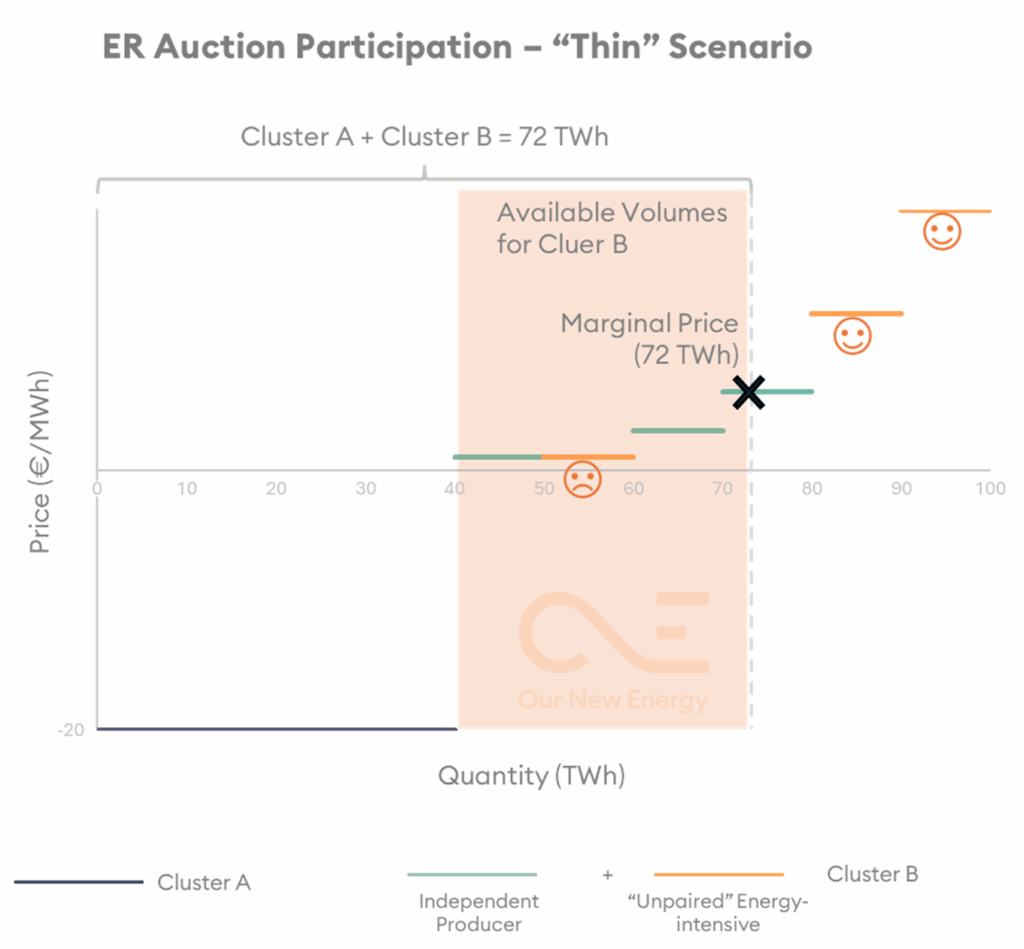
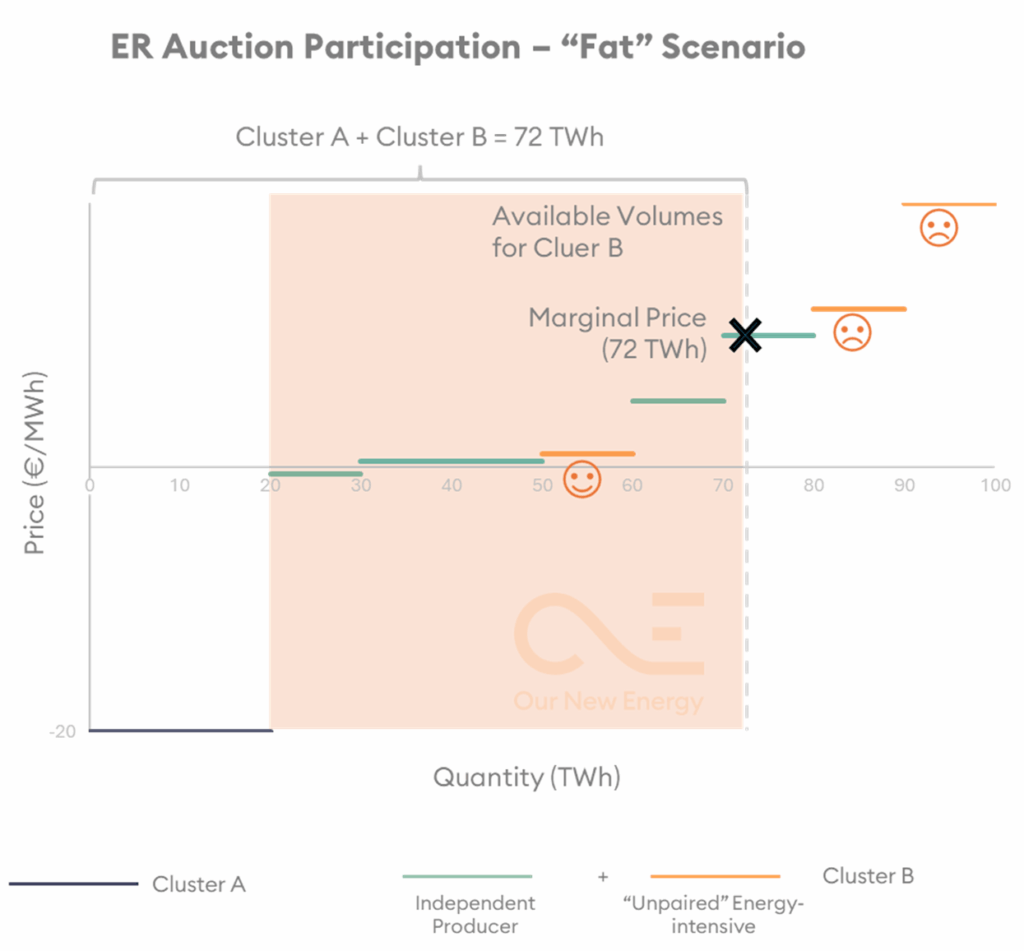
The volumes within Cluster A directly reduce the overall contingent available for independent third-party producers in Cluster B. Indeed, the sum of the two clusters (A+B) adds up to the total amount of the anticipation volumes (72 TWh). In order to freeze the picture of such volumes, GSE has put on hold Addendum execution after the 9th of March and until the auction results.
Another key factor for determining the marginal price is the competition level among producers. With this regard, FER X recent auction has shown that the pipeline of genuinely ready projects might be smaller than anticipated.
Moreover, projects interested in FER X are not necessarily suited for the more complex and riskier ER, firstly given the substantial 40 €/MWh liability for awarded producers in case of failure to reach COD—a risk very challenging for lenders. Additionally, ER’s possible extension of up to additional 20 years strongly reduces the asset «tail value», making this mechanism far less attractive for developers and short-term investors compared to FER X.
EIC bidding scenarios: navigating the trade-offs of risk-aversion vs. risk-taking
We explained before that the goal of an EIC is losing the competitive procedure.
An EIC aiming to guarantee a loss would theoretically offer a high premium. However, the risk of paying an exceedingly high marginal premium and the possibility of delegating the restitution obligations also after the auction make this strategy far too simplistic. We have classified two opposite EIC bidding behaviors, yet both possible:
- Risk-Averse EICs: these corporates prioritize being relieved of the construction and restitution obligations at almost any cost. They will submit a high bid to ensure they lose, accepting the risk of a high marginal premium. It is though reasonable to suppose an upper limit for such bids.
Assuming they act as rational operators, they won’t bid too far from the fee that some of the most aggressive aggregators asked in late 2024/early 2025 to take on these obligations (up to 50% of the anticipation benefit); otherwise, rationally, they should have partnered with those aggregators back then.
- Risk-Taking EICs: These EICs aim to maximize their payoff and are willing to accept the risk of winning the auction (with the intention of subsequently delegating obligations). They seek to avoid paying a high marginal premium. This strategy manifests in two forms:
- Aggressive Players: potentially medium and large volume EICs, often Italian owner-managed companies, highly informed on ER that might have already delegated part of their volumes via the Addendum. They will bid a low premium, maybe even lower that the values currently exchanged on the market, hoping to either lose (and hopefully pay a very low marginal premium due to high competition) or, if they win, ensure their aggressive bid helps drive down the marginal premium, setting a lower reference point for future bilateral deals. It is crucial to remember that if producer competition is less than anticipated, or if many EICs are risk-averse, the marginal premium may not drop significantly, potentially clearing at very high premiums, which they will then be obliged to pay. In other words, them being wrong can cost a lot financially.
- «Wait-and-See» Players: these EICs will bid what they are actually willing to pay to get rid of the construction and restitution obligations and see what happens. Even through this approach though, they still face the risk of winning if producer competition is lower than expected.
Producers bidding scenarios: how many distressed players are out there?
The bidding behavior of Cluster B producers may essentially range between two extremes:
- Distressed producers: these are likely producers without FER X awards nor bilateral negotiations. They might be bid aggressively low. A couple of considerations here:
- Producers deeply engaged with ER have mostly already secured bilateral contracts. Therefore, the average level of information regarding ER and its associated risks among these distressed producers might not be as profound. This could lead them to underestimate the claw back value and, consequently, their required premium, as their primary goal is winning.
- It is very optimistic for EICs to think that bidding a negative premium is an option, even for “the most destressed among the destressed”. Firstly, it’s counter-intuitive to explain to both equity and debt providers, and more critically, it would require them to provide a cash outflow before having an operational plant (and, on top, all the construction risk)
- Strategic producers: this group includes independent producers who have already contracted portions of their portfolio via bilateral agreements or have secured FER X. They see the auction as a free option to improve their financial position, and they are unlikely to trade the ER mechanism for a low premium. It is reasonable to assume these producers will bid higher than the premiums currently observed in the bilateral market.
Concluding thoughts on the bidding strategies
Considering all the aforementioned factors, we can envision two primary auction scenarios:
- Thin Auction Scenario: this scenario occurs if a high number of bilateral deals are concluded, leaving little available volume for Cluster B producers. Even with moderate producer competition, the auction is more likely to close at a low marginal premium. In this case, EICs adopting a risk-averse strategy would find it to be the most advantageous behavior.
- Fat Auction Scenario: this scenario arises from a low number of bilateral deals, that leaves room for Cluster B producers. Here, a risk-taker strategy might prove most effective for EICs, especially if the number of distressed producers bidding aggressively low is limited, potentially leading to a higher clearing marginal price.
From this scenario analysis, which summarizes all the considerations discussed in this article, it is evident that the primary driver for the auction outcome is the available contingent and we are actively working to better dimension this crucial factor.
The second key driver will be the number of «distressed» producers in the market. As mentioned, banks perceive ER as a complex and risky mechanism – due to the 40 €/MWh liability in case of COD failure and the fact that only 50% of revenues are contracted versus the desired 70-80% for project financing – and many producers have already opted for bilateral contracts.
From the EICs’ perspective, while some «risk-taker» consumers will certainly participate and assuming producers are unwilling to pay upfront (i.e., negative premiums) to enter the mechanism, the payoff for them appears asymmetrical and unfavorable for them. In other words, they can lose much more money than what they could potentially earn compared to a bilateral agreement.
The evolution of the bilateral agreements market in the next few weeks will be decisive to steer the appetites and drive the strategies of the different auction participants.
Our New Energy at a glance
As Our New Energy, we are the leading European consultancy company in renewable energy transactions. We have offices in Spain, Italy, Denmark, Germany and Poland and together we cover all Europe, Japan, and South America.
In the Energy Release domain, we have proudly assisted our producer clients in closing over 10 TWh of bilateral agreements, enabling them to secure their roles as delegated third-party producers and signatories of the Addendum.
Our current pipeline across PPA and ER transactions demonstrates our commitment to helping producers successfully negotiate their revenue contracts. If you are a producer without an existing bilateral contract or keen to explore participation in the Energy Release competitive procedure, or an energy-intensive corporate seeking a bilateral contract to delegate your restitution obligations, we invite you to connect with our Italian office, reach out to Dario and Sofia Our New Energy is dedicated to working with our producers to provide them with the necessary tools and insights to support well-founded strategic decisions.
Recent Post

ONE acquires 30% stake in ENZEE
ONE acquires 30% stake in ENZEE Get in touch ONE acquires 30% stake in ENZEE Our New Energy’s investment vehicle...
Learn More
ITALY | Energy Release 2.0: Navigating the Competitive Auction
Energy Release 2.0: Navigating the Competitive Auction Get in touch ITALY | SOLAR – Energy Release 2.0: Navigating the Competitive...
Learn More
ITALY | SOLAR – Energy Release 2.0: Navigating the Wave of Bilateral Deals
Energy Release 2.0: Navigating the Wave of Bilateral Deals Get in touch ITALY | SOLAR – Energy Release 2.0: Navigating...
Learn More