
Energy Release 2.0: Navigating the Wave of Bilateral Deals
ITALY | SOLAR – Energy Release 2.0: Navigating the Wave of Bilateral Deals
Monday, January 19, 2026
Having already secured over 10 TWh out of the 72 TWh available in the mechanism for renewables investors, and while engaging in discussions on many more, our Italian team shares an updated view of the market for bilateral agreements under Energy Release 2.0
The new year starts with corporate deals
The Italian Energy Release 2.0 mechanism, designed to foster new renewable energy capacity while providing a reduced electricity price to energy intensive consumers, has seen significant activity. While prior to the recent holiday period, most aggregators successfully closed their delegated third-party producer agreements, efficiently allocating their volumes, the spotlight now shifts decisively to energy-intensive corporates, who must strategically engage with this framework to secure the restitution of their allocated volumes.
Unpacking bilateral contracts with Energy Intensive Consumers
Under a bilateral agreement within the Energy Release framework, the EIC delegates to the Producer, or its affiliates, all obligations set out in the Addendum. These include (i) developing new renewable generation capacity capable of producing the agreed-upon restitution volumes, (ii) returning the counter-value of the related Guarantees of Origin (GOs) to GSE, and (iii) managing any Residual Advantage.
Restitution Volume
One of the key elements in negotiating these agreements is the restitution volume. Before Addendum execution, market practice is to commit to a fixed volume, precisely defined by the EIC based on its individual allocation from GSE. The EIC therefore commits to maintaining the contracted volume throughout the term of the agreement. In certain cases, limited flexibility, generally in the range of a few percentage points (±1/3%), may be granted by the third-party producer.
After Addendum execution, the restitution volumes remain fixed towards GSE even if the EIC decreases the anticipation volumes.
Consideration, Payment Terms and Guarantee
It is well established in the market that the financial consideration payable by the EIC to the Producer under ER bilateral agreements typically ranges between 6 and 9 €/MWh, depending on agreement size and terms. Only in few instances involving very large volumes have price levels dropped below ranges. This firm consideration reflects the value attributed to the loss of the asset’s merchant tail beyond year 20, resulting from the extension of the restitution period. As a result, the primary negotiation focus is generally not the level of consideration itself, but rather the associated payment terms.
Market practice typically provides for payment to be split into two tranches. The first tranche is usually paid upon execution of the Addendum. The second tranche, however, is subject to negotiation, and its structure has a direct impact on the guarantee requirements under the bilateral agreement.
- Deferred payment with guarantee: Payment of the remaining 50% upon receipt of the 2025 advance benefit by the EIC and, in any event, no later than a long-stop date, usually 31st March 2026. This structure might require the EIC/Aggregator to provide the producer a guarantee covering the deferred amount. The guarantee is typically set equal to the consideration multiplied by the contracted volumes.
- Accelerated payment without guarantee: To circumvent the need for a guarantee, payment of the remaining 50% upon release of the cash deposit by the Producer to GSE’s as unconditional guarantee. Under this structure, both parties’ contractual obligations are settled swiftly, eliminating the need for any guarantee from either party.
Debt provider’s approach to Energy Release
Although Energy Release 2.0 has been under discussion for more than a year, recent regulatory adjustments and the inherent complexity of the mechanism have led debt providers to engage in depth with its implications only recently.
From a project finance perspective, the extension of the CfD beyond year 20 at a reduced strike price is not viewed as a material concern, as this additional period mostly falls outside the typical financing period. Instead, lenders tend to focus on two other risk areas.
Firstly, what becomes of the 50% of volumes not contracted under Energy Release? While the ideal scenario would be to have contracted the remaining electricity under FER X, where this is not feasible, in order to offer attractive leverage and competitive debt costs, some lenders require this residual output to be covered by medium-term Power Purchase Agreements (PPAs), typically with a duration of 5 to 7 years.
Secondly, banks meticulously assess the worst-case scenario: a producer failing to connect the plant within the 40-month deadline and consequently defaulting vis-à-vis GSE under the ER framework. In such a case, the producer’s liability would be significant, corresponding to the full benefit received by the EIC during the three-year anticipation period (approximately €40/MWh).
That said, several important mitigating factors exist. The 40-month COD deadline is relatively generous and provides reasonable development flexibility. In addition, GSE allows for force majeure exemptions from this deadline, coveringnot only traditional force majeure events but also administrative delays, with an ultimate longstop date of 31 December 2030.
Finally, unlike in FER X, producers have the additional flexibility of signing the addendum with the group holding and nominating the restituting plants to GSE only at a later stage (up to 40 months), further mitigating the risk.
GSE auction – Risk or opportunity for producers?
One of the most distinctive features of Energy Release 2.0 lies in the coexistence of Cluster A and Cluster B producers, which reflect two fundamentally different pathways to allocation, and shape the strategic behavior of market participants.
Cluster A includes producers that have already signed a bilateral Addendum with an EIC or aggregator. These projects benefit from an automatic allocation at a fixed bid of –20 €/MWh and are not subject to competitive ranking. For Cluster A projects, no specific development or grid-connection milestones are required, and projects benefit from a relatively long construction period of 40 months. However, the SPV or its holding must meet the same financial solidity requirements as under FER X.
Cluster B, on the other hand, is the competitive arm of the mechanism and is open to third-party producers that have not secured a bilateral agreement. These participants must submit a bid relative to the Energy Release strike price of 65 €/MWh, down to a floor of –20 €/MWh and are ranked in ascending order of price. Successful bidders are then matched, at the marginal clearing price, with EIC that has not designated a third-party producer via an Addendum. Entry into Cluster B requires a more advanced level of project maturity, including the availability of all authorizations and an accepted grid-connection offer, and assets have 36 months to achieve COD. Nonetheless, the financial capacity can be simply demonstrated through a declaration from a banking institution.
Auction bidding behavior by consumers will be based on game theory
If an EIC wins the auction, it effectively commits to developing a renewable asset; if it loses, it is relieved of construction obligations, and its restitution volumes are instead allocated to a third-party producer. Counterintuitively, this means that the corporate’s optimal outcome is to lose.
The final auction outcome depends not only on bid prices, but also on the volumes already secured under Cluster A: ceteris paribus, the greater the number of bilateral agreements signed in advance, the lower the marginal price at which the auction is likely to clear.
Consequently, “unpaired” EIC” participation decisions depend on expectations for Cluster A: probability of losing the auction for EIC increases if many bilateral agreements are expected to be signed.
The current premium level available on the bilateral market is encouraging EIC/aggregators to secure bilateral agreements rather than participating in the auction and risking paying much higher premiums. Given the historically heterogeneous behavior of EICs on energy management topics, time will tell how crowded the auction foreseen for Q1–Q2 2026 will be.
Recent Post

ONE acquires 30% stake in ENZEE
ONE acquires 30% stake in ENZEE Get in touch ONE acquires 30% stake in ENZEE Our New Energy’s investment vehicle...
Learn More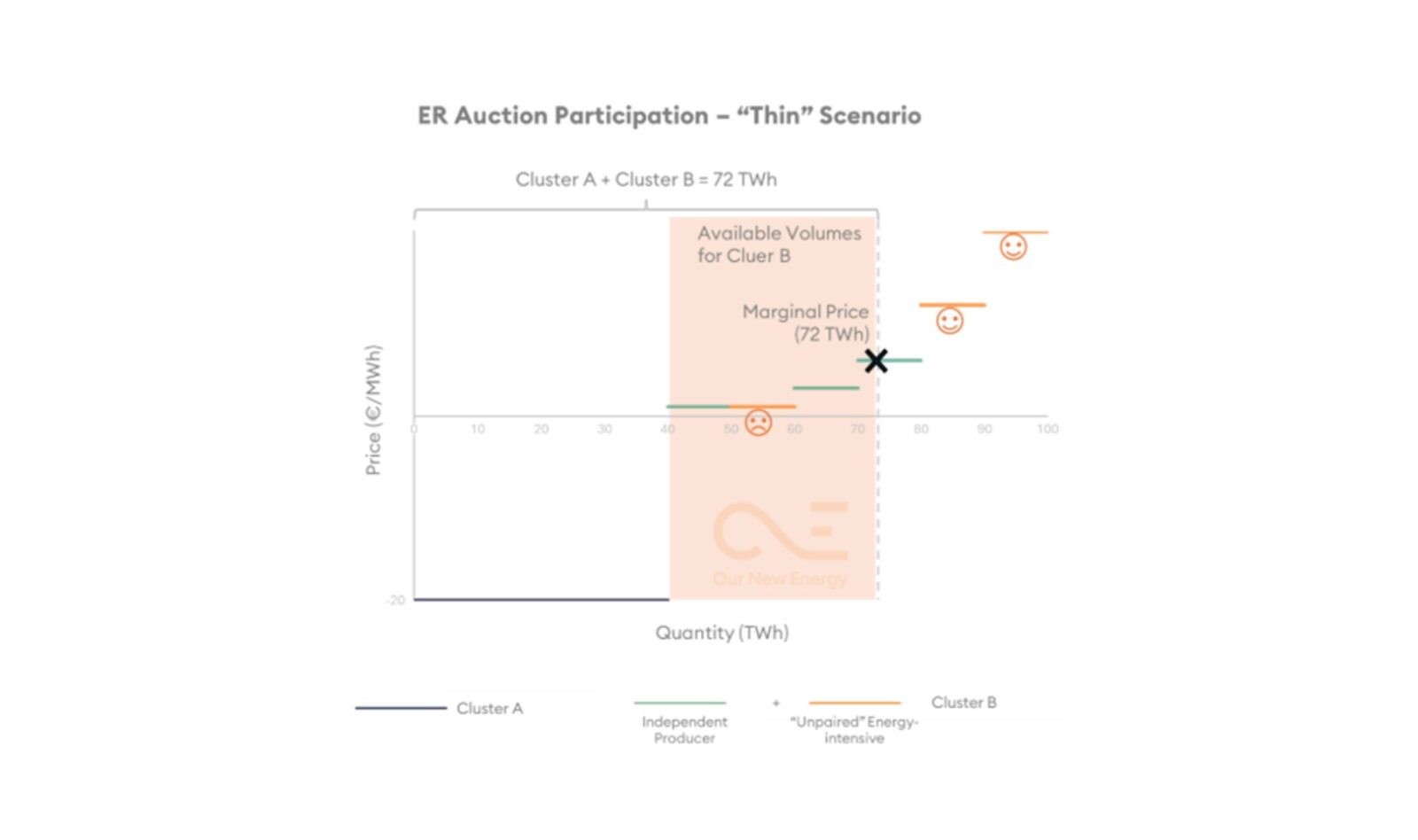
ITALY | Energy Release 2.0: Navigating the Competitive Auction
Energy Release 2.0: Navigating the Competitive Auction Get in touch ITALY | SOLAR – Energy Release 2.0: Navigating the Competitive...
Learn More
ITALY | SOLAR – Energy Release 2.0: Navigating the Wave of Bilateral Deals
Energy Release 2.0: Navigating the Wave of Bilateral Deals Get in touch ITALY | SOLAR – Energy Release 2.0: Navigating...
Learn More